

DeZi at the World Health Assembly Side Event
2024 was the worst dengue year on record. More than 14 million cases were reported across over 100 countries. Yellow fever continues to cause outbreaks across the Americas. While dengue, Zika and chikungunya are now spreading faster than almost any other vector-borne threat — carried by mosquitoes adapting to a warming world.
Where mosquitoes go, epidemics follow — and the countries on the front line have always held the answers. The DeZi Network was built to fund, connect and amplify them.
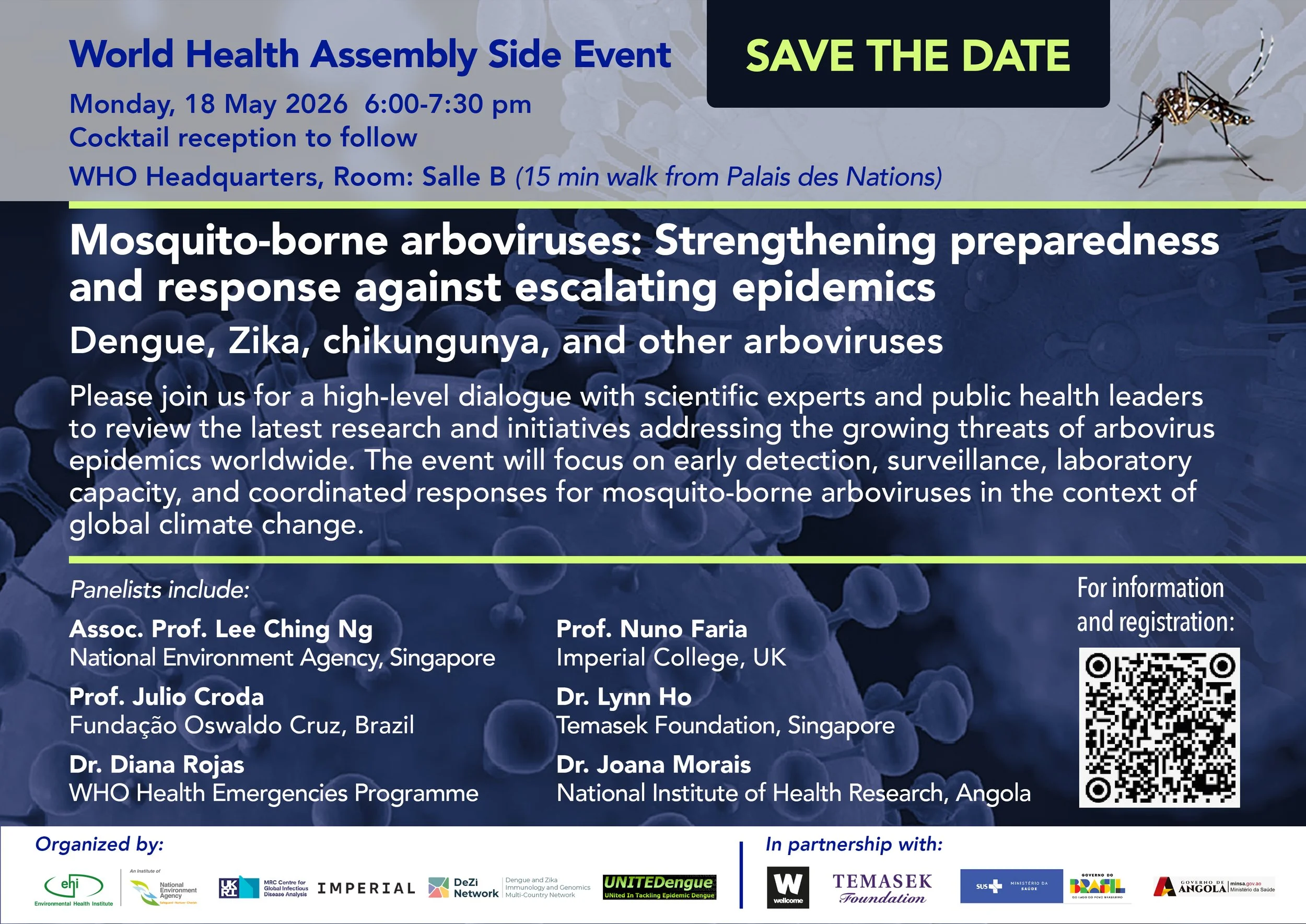
During the 79th World Health Assembly, DeZi is pleased to co-organise an official side event in Geneva: "Dengue, Zika, chikungunya, and other mosquito-borne arboviruses — strengthening preparedness and response against escalating epidemics."
Over half the world's population lives in arbovirus-endemic areas. This side event brings ministries of health, WHO experts, scientific leaders and global health partners together to review what is working in early detection, surveillance, laboratory capacity and coordinated response — and what still needs investment.
📍 Salle B, WHO Headquarters, Geneva· 15-minute walk from Palais des Nations
📅 Monday 18 May 2026 · 18:00–19:30 CEST· cocktail reception to follow
💻 Hybrid event· in-person seating and reception are limited, please register early
Organised by Prof. Nuno Faria (Imperial College London; WHO Collaborating Centre, UK), Assoc. Prof. Lee Ching Ng (National Environment Agency; WHO Collaborating Centre, Singapore) and Dr. Natsuko Imai-Eaton (Wellcome Trust). Co-sponsored by the Ministries of Health of Singapore, Brazil and Angola, and by the Temasek Foundation.
Confirmed speakers and panellists: Prof. Julio Croda (Fundação Oswaldo Cruz, Brazil), Prof. Nicaise Ndembi (International Vaccine Institute), Assoc. Prof. Joana Morais (Instituto Nacional de Investigação em Saúde, Angola), Dr. Diana Rojas and Dr. Lorenzo Subissi (WHO Health Emergencies Programme), and Dr. Lynn Ho (Temasek Foundation, Singapore) — alongside the organisers.
The full programme will be published in early May.