

Climate and land use shape Oropouche outbreaks across Brazil
Abstract
Oropouche virus (OROV) is a neglected arbovirus that has caused outbreaks in Central and South America since the 1950s, with a major resurgence underway since late 2023. We investigated the ecological and demographic determinants of Oropouche fever in Brazil between 2014 and 2025.
Combining national surveillance, genomic and ecological data, we analysed 30,086 laboratory‑confirmed Oropouche fever cases reported across 894 (16.1%) of 5,570 municipalities in all 26 states and the Federal District. The cumulative incidence of OROV in rural municipalities was 11.3 times higher than in urban municipalities, with a median urban‑to‑rural case ratio of 0.6 — contrasting sharply with dengue, chikungunya and Zika (2.5–2.8).
After fluctuating in the North Region before its 2024 expansion, OROV spread southwards with transmission peaks (Rt) ranging from 3.2 to 5.5. Statistical risk modelling identified warm winter temperatures, humidity, banana and rubber cultivation, and the human footprint index as the strongest predictors of outbreak probability, revealing pronounced spatial and seasonal heterogeneity in OROV risk across Brazil.
These findings provide the first comprehensive ecological and demographic assessment of Oropouche fever in Brazil and highlight that arboviral surveillance and control programmes focused on Aedes mosquitoes alone are insufficient: containing OROV requires expanded measures targeting Culicoides midges, particularly in rural and peri‑urban agricultural areas.
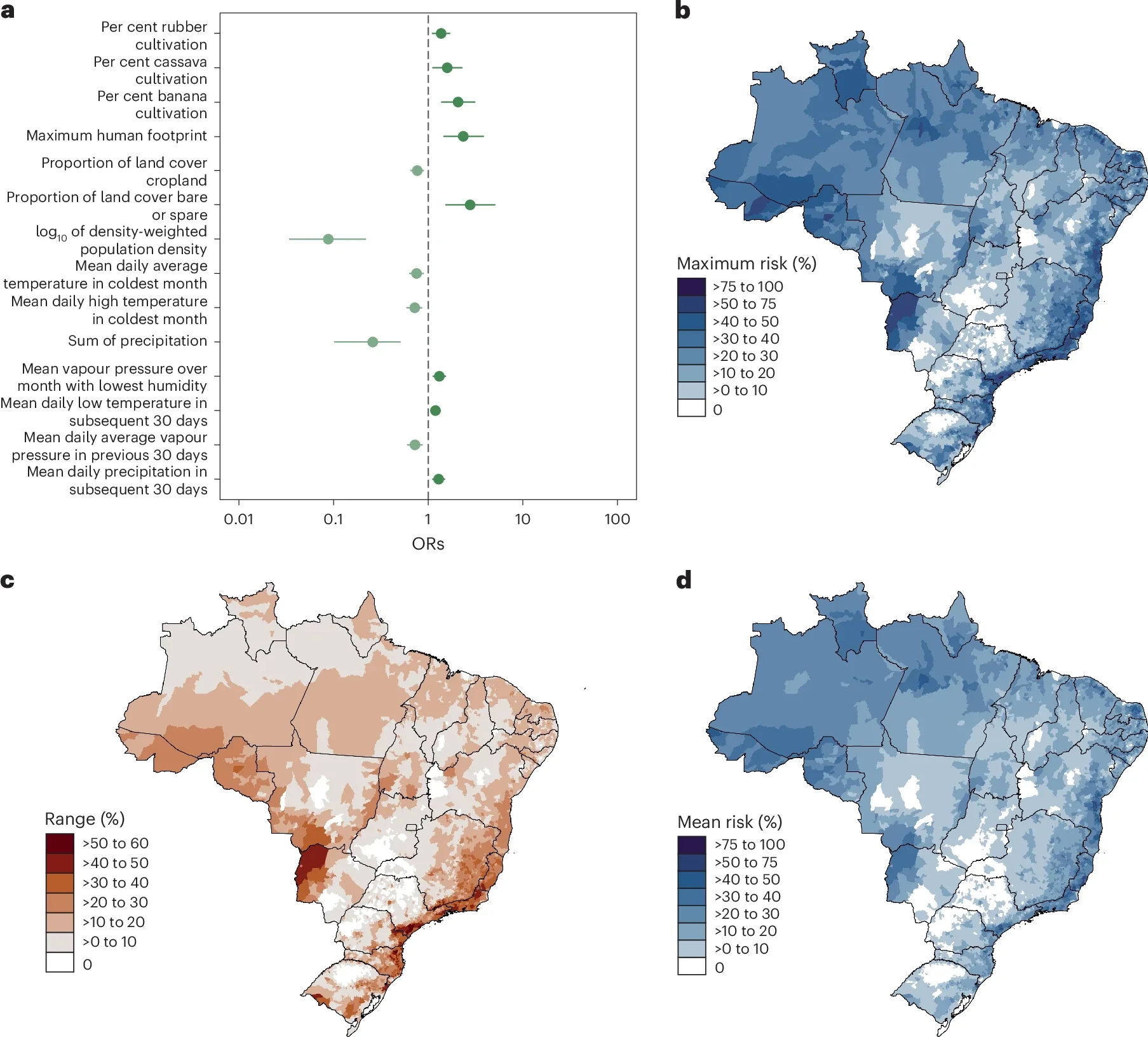
Figure. Municipality‑level risk maps of OROV outbreaks in Brazil following an OROV case introduction, based on monthly climate normals. (b) Highest percentage risk for each municipality across the year. (d) Estimated 12‑month average outbreak risk by municipality.
Context
Our new study published in Nature Health provides the most comprehensive analysis to date of Oropouche fever in Brazil, combining over a decade of national surveillance data with genomic, ecological and climatic indicators to characterise where and why outbreaks occur. The work shows that — unlike dengue, chikungunya and Zika — OROV transmission is concentrated in rural municipalities, driven by interactions between climate, agricultural land use, and the ecology of Culicoides paraensis midges.
The findings have direct implications for arboviral preparedness across Latin America: they identify seasonal windows of highest outbreak risk, flag specific agricultural settings (banana and rubber cultivation) as ecological hotspots, and underscore the limits of current Aedes‑focused vector‑control programmes for an arbovirus whose primary vector breeds in different habitats. This work aligns closely with DeZi's mission to integrate genomic, epidemiological and ecological data to strengthen surveillance and decision‑making for emerging arboviruses.