

Oropouche transmission dynamics in Latin America
Context
Oropouche fever has emerged as a significant public health threat in Latin America, with over 10,000 cases reported in 2024 alone. Similar to Zika virus, OROV can cause severe neurological complications and has the potential for explosive urban outbreaks. This research provides the foundational knowledge needed to predict and prevent future epidemics.
Abstract
Oropouche virus (OROV) is an arbovirus endemic to the Amazon region since the 1950s that re-emerged in late 2023, causing a major epidemic across Central and South America. Here we investigated the transmission dynamics of the 2023–2024 epidemic in Manaus City (Amazonas state, Brazil), a major metropolitan hub in the Amazon, and estimated OROV infections across Latin America and the Caribbean. OROV re-emergence in Manaus resulted in an increase of IgG seroprevalence from 11.4% in November 2023 to 25.7% in November 2024. The neutralizing capacity of OROV-specific IgG antibodies from individuals collected before and after the re-emergence demonstrated a median plaque reduction neutralization test 50% titer of 640 against both the historical and contemporary OROV isolates. A historical reconstruction of OROV circulation in Manaus indicated a continuous low-level transmission with two major outbreaks of comparable seasonality and magnitude in 1980–1981 and 2023–2024. We estimate approximately 336,000 OROV infections in the Amazon region under a scenario of continuous endemic transmission without major outbreaks and over 9.4 million OROV infections during major outbreaks from 1960 to 2025. Collectively, our findings provide a comprehensive assessment of OROV transmission in Manaus and contribute to a better understanding of the OROV burden.
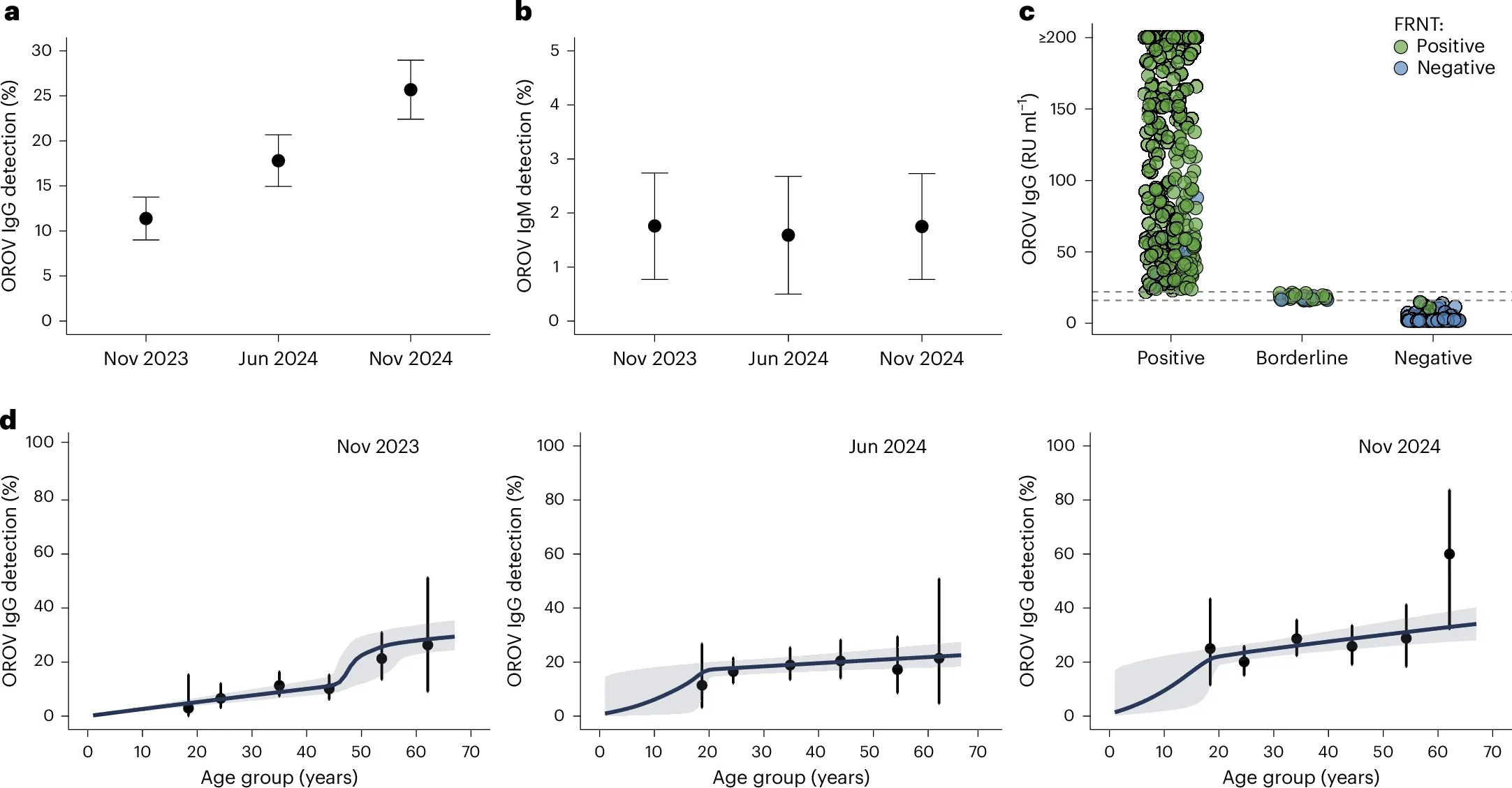
a, OROV IgG seropositivity rate by sampling period. Seropositivity rates are shown for three time points (November (Nov) 2023, June (Jun) 2024 and Nov 2024) among individuals aged 16–69 years (n = 685 per period). The dots represent observed seroprevalence and error bars indicate 95% CIs. b, OROV IgM seropositivity rate by sampling period. Seropositivity rates are shown for three time points among individuals aged 16–69 years: Nov 2023 (n = 683), Jun 2024 (n = 504) and Nov 2024 (n = 685). The dots represent observed seroprevalence and error bars indicate 95% CIs. c, The agreement between IgG ELISA and FRNT (n = 630). The upper dashed line indicates the cutoff for IgG positive (≥22 RU ml−1), while the lower dashed line indicates IgG negative (<16 RU ml−1) as established by the manufacturers. The area between the two dashed lines represents the borderline range (≥16 to <22 RU ml−1). d, Age-stratified OROV-specific IgG seroprevalence in Manaus across three sampling periods: Nov 2023, Jun 2024 and Nov 2024. The posterior distribution of the catalytic model fitted seroprevalence for each age is represented as posterior mean (dark blue) and 95% credible intervals (shaded gray). The dots represent the observed seroprevalence and bars indicate the 95% CIs. Seropositivity rates are shown for three time points (Nov 2023, Jun 2024 and Nov 2024) among individuals aged 16–69 years (n = 685 per period).
______
Behind the paper
This collaborative effort between institutions across Latin America represents the most comprehensive OROV analysis to date. By combining genomic surveillance data with detailed transmission modeling, the research provides actionable intelligence for outbreak preparedness and response strategies.
The key breakthrough was the integration of diverse data sources: mosquito surveillance, clinical case reports, and viral genomic sequences. This multidisciplinary approach revealed that OROV transmission patterns are more complex and geographically extensive than previously understood.
______