

Real‑time AI nowcasting for dengue in São Paulo
Abstract
Nowcasting methods are crucial in infectious disease surveillance, as reporting delays often lead to underestimation of recent incidence and can impair timely public health decision‑making. Accurate real‑time estimates of case counts are essential for resource allocation, policy responses, and communication with the public.
We propose a novel probabilistic neural network architecture, NowcastPNN, to estimate occurred‑but‑not‑yet‑reported cases of infectious diseases, demonstrated here using daily dengue fever incidence in São Paulo, Brazil. The model combines a Negative Binomial generative model of the true number of cases with recent advances in deep learning, including the attention mechanism, and quantifies uncertainty by sampling from the predicted distribution and using Monte Carlo dropout.
Using proper scoring rules for prediction intervals, NowcastPNN achieves nearly a 30% reduction in losses compared with the second‑best of several state‑of‑the‑art approaches. While the model benefits from a large training dataset (equivalent to two to four years of incidence counts) to fully outperform benchmarks, it is computationally cheap and remains competitive even with significantly fewer observations as input.
These features make NowcastPNN a promising tool for real‑time epidemiological surveillance of arboviral threats and other domains involving right‑truncated data, where timely and well‑calibrated estimates of recent incidence are essential for outbreak response.
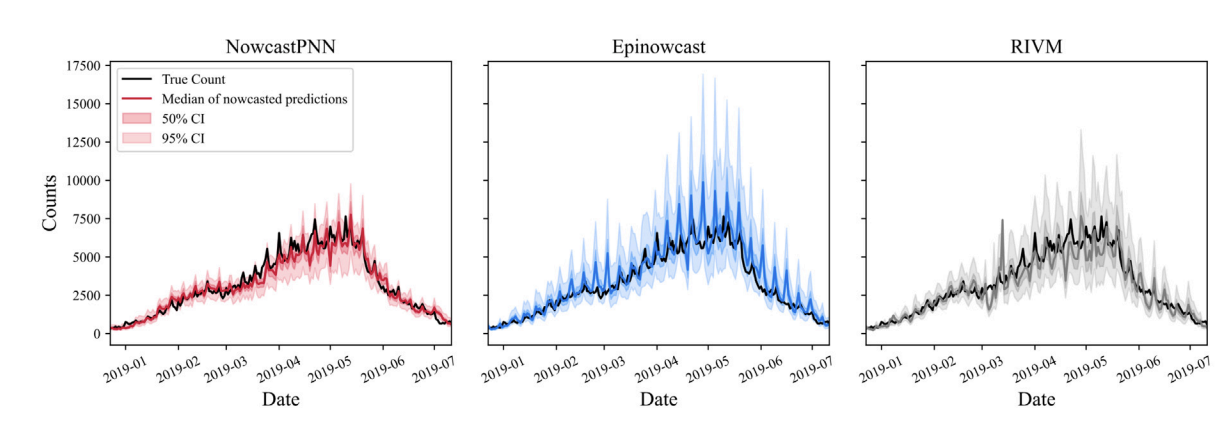
Figure. Comparison of same-day nowcasts produced by evaluated models showing daily dengue case counts in São Paulo during the 2018–2019 evaluation window. NowcastPNN's posterior median (line) and 95% prediction interval (shaded band) are overlaid on the as‑reported case counts (light grey) and the eventually finalised counts (dark grey), illustrating how the model recovers true incidence in real time despite reporting delays.
Conclusions
Our new open‑access study, published in Epidemics as part of the journal's "AI for ID modelling" special issue, presents NowcastPNN. This deep‑learning model corrects for reporting delays in infectious disease surveillance and produces well‑calibrated, real‑time estimates of how many cases have actually occurred. Using daily dengue surveillance data from São Paulo state (2013–2020), the model outperforms current benchmarks while remaining computationally lightweight enough to run on routine surveillance infrastructure.
For dengue specifically, where Brazil now experiences over 10 million cases in peak years and reporting delays of weeks can mask the true scale of an outbreak, faster and more accurate nowcasts directly improve resource allocation, public communication, and outbreak response. The architecture generalises beyond dengue to any disease surveillance system with right‑truncated data, supporting DeZi's mission to strengthen near‑real‑time situational awareness for emerging arboviral threats across our partner countries.