

DENV-2 in Madeira's mosquitoes
In January 2025, two related patients in Funchal, Madeira's capital, presented with dengue-like symptoms — neither had travelled, raising the prospect of local transmission. A new brief report in Parasites & Vectors, led by Dr. Líbia Zé-Zé and Dr. Vítor Borges (INSA) with senior authors Prof. Nuno R. Faria and Prof. Maria João Alves (INSA), closes the loop on the event with combined entomological, clinical and genomic surveillance.
Of 80 Aedes aegypti pools collected near the patients' homes between January and March, one — nine mosquitoes — tested positive for DENV. Whole-genome sequencing identified the virus as DENV-2 lineage 2II_F.1.1.3, and the same lineage was retrospectively confirmed in one of the clinical samples, providing a direct molecular link between human and mosquito infections. Strikingly, transmission occurred during a period of low mosquito abundance and low climatic suitability — a reminder that off-season arboviral introductions remain a real risk in Europe, and that integrated surveillance is what catches them.
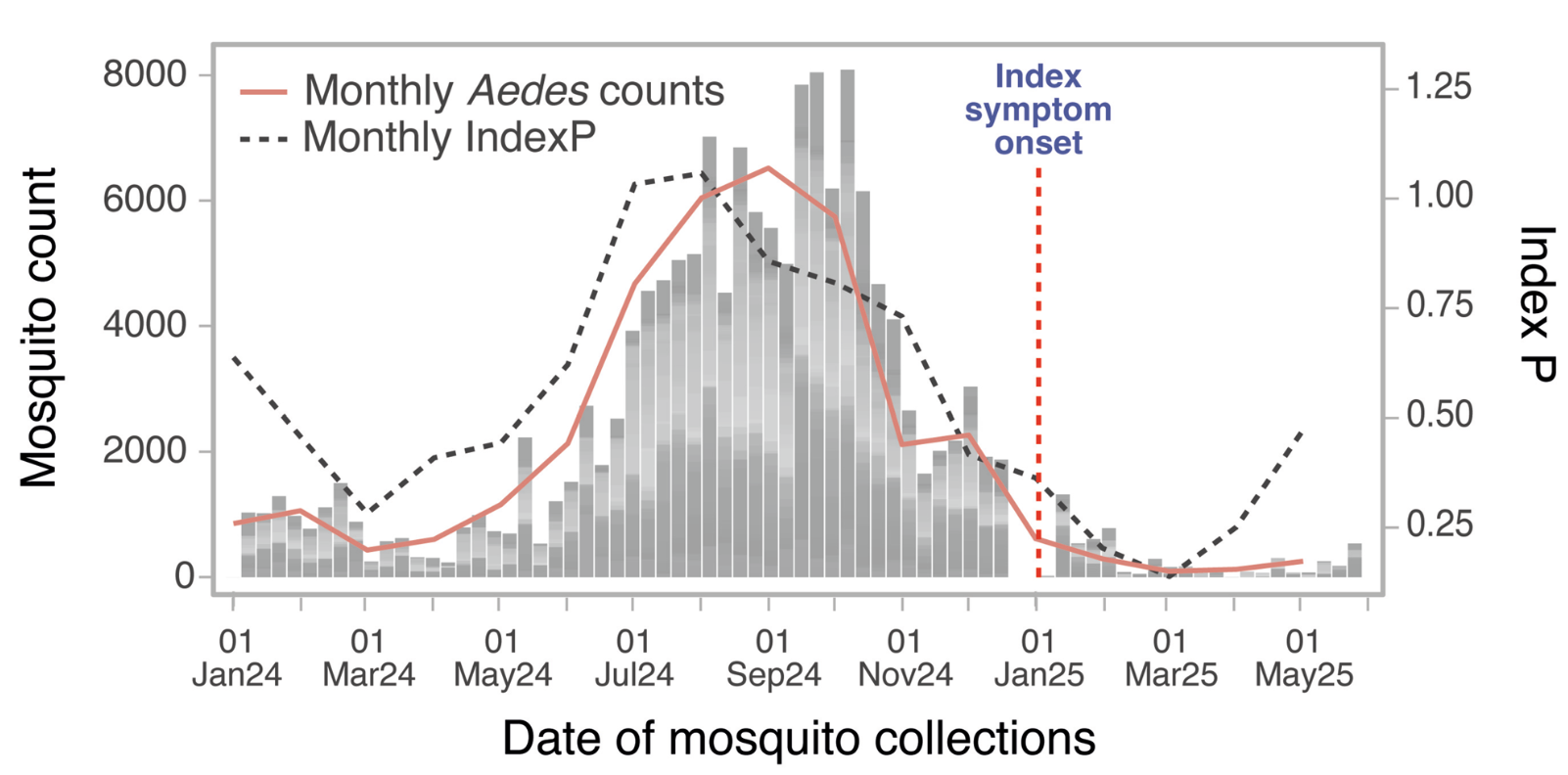
Figure. Weekly A. aegypti egg counts (grey bars), monthly A. aegypti egg counts (salmon line) and monthly climatic transmission suitability (unlagged IndexP, black dashed line) for 2024–2025. Symptom onset of Case 1 is indicated by a red vertical dashed line.