

Mapping Oropouche seroprevalence across the Americas
Abstract
Oropouche virus (OROV) is an emerging arbovirus, primarily transmitted by biting midges, that is increasingly recognised as a public health threat across Central and South America. Over 11,000 confirmed cases were reported in 2024 — a tenfold rise on the previous year — yet OROV's true burden and transmission dynamics remain poorly understood, hampered by diagnostic challenges and fragmented surveillance.
This systematic review and meta‑analysis synthesises OROV prevalence data in humans, and summarises available evidence in vectors and animal hosts, sampled between 2000 and 2024. We searched five databases (Web of Science, PubMed, Embase, Medline and LILACS) to September 2024, extracted 71 studies in duplicate, meta‑analysed prevalence using generalised linear mixed‑effects models, and appraised risk of bias with a modified Joanna Briggs Institute checklist.
Across nine countries, pooled human seroprevalence among individuals with febrile illness or suspected OROV infection was 12.6% (95% CI 5.3–26.9%) in four South American countries, with viral prevalence of 1.5% (0.8–3.0%) across seven countries plus Haiti. Asymptomatic seroprevalence was 1.1% (0.5–2.3%). OROV was detected in Aedes aegypti and Culex quinquefasciatus in two of 18 vector studies, and in 10.0% and 7.5% of dogs and cattle sampled, respectively. Most studies relied on convenience sampling, with 11.3% rated high risk of bias and the majority moderate.
These results show that despite rising case numbers, prevalence estimates remain limited by sparse and methodologically heterogeneous surveillance — particularly in animal reservoirs and vectors. The review highlights the urgent need for standardised serological assays, community‑based studies, and a One Health approach combining human, animal and vector surveillance to monitor OROV transmission and inform regional preparedness.
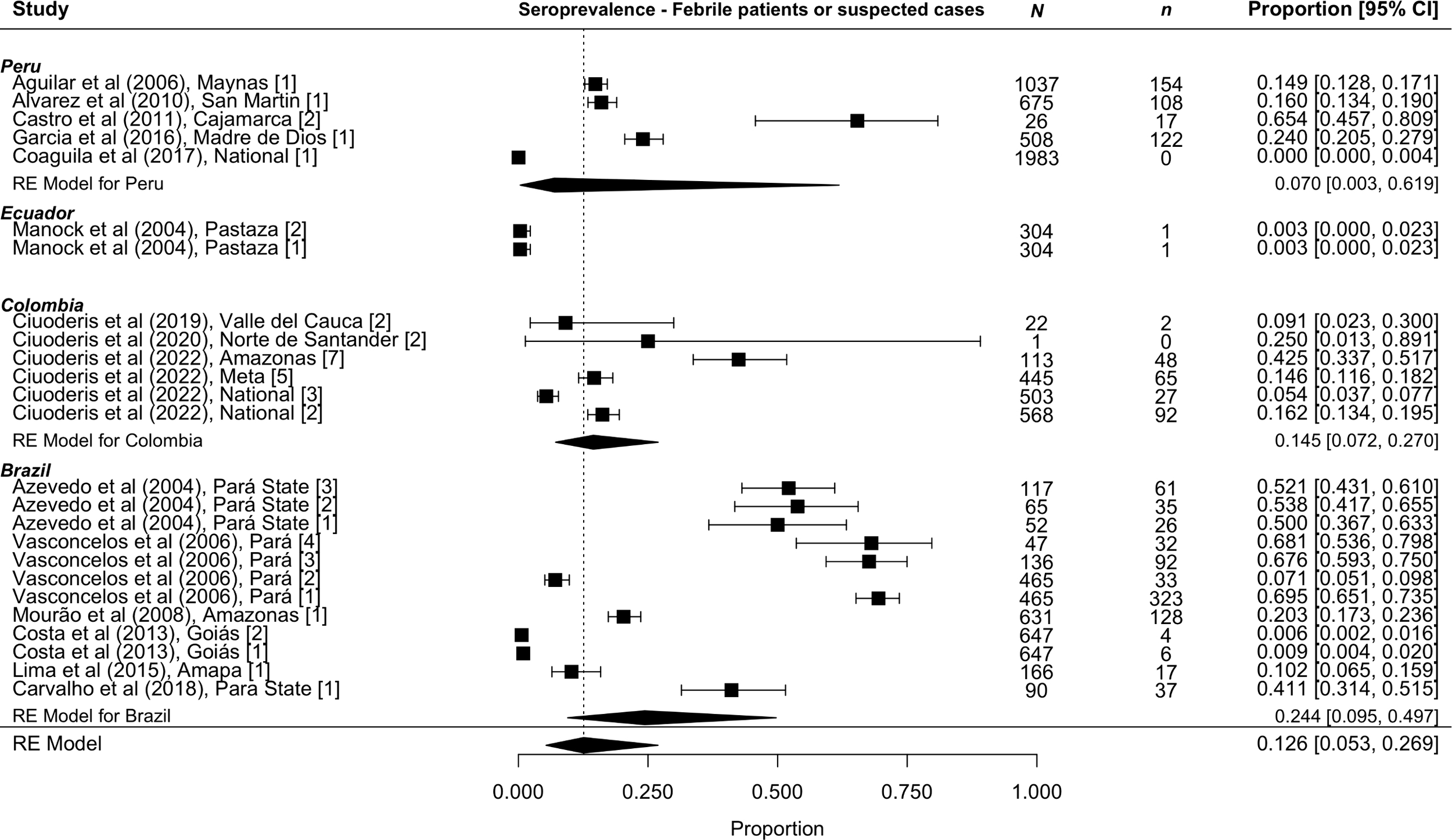
Figure. Reported pooled seroprevalence from studies sampling participants with febrile illness or suspected of Oropouche infection in 2000 to 2024. Seroprevalence is displayed as a proportion with 95% confidence intervals in square brackets.
Context
Our new open‑access study, published in PLOS Neglected Tropical Diseases, provides the first systematic review and meta‑analysis of Oropouche virus prevalence across humans, vectors and animal hosts, drawing on 71 studies from nine countries published between 2000 and 2024. The findings put hard numbers on what surveillance authorities have suspected: roughly one in eight people presenting with febrile illness in affected regions of South America carries serological evidence of past OROV infection, while active viral prevalence sits near 1.5% — figures that imply a far larger circulating reservoir than confirmed case counts alone suggest.
The review also makes plain how thin the evidence base remains, especially in animals and vectors, and how heterogeneous diagnostic methods have complicated comparison across studies. Its call for standardised assays, community‑based seroprevalence work, and integrated human–animal–vector surveillance directly aligns with DeZi's mission to strengthen One Health surveillance for emerging arboviruses across our partner countries. The compiled dataset is openly available through the ArboTracker dashboard, providing an interactive starting point for researchers and public‑health teams.