

Tracking the arrival of DENV3 in Angola
A new Research Letter in Emerging Infectious Diseases reports the first detection of DENV-3 lineage III_B.3.2 in Angola — a virus that genomic analysis suggests was introduced from the Americas in late 2022 and had been circulating locally before its detection.
Co-led by Jocelyne Neto de Vasconcelos, Ingra M. Claro and Raissa H. de Araujo Eliodoro, the team tested 136 febrile patients at three Luanda clinics during April–November 2024. Sixteen (11.8%) were DENV-positive; nanopore sequencing recovered six DENV-3 genomes, all clustering into a single clade most closely related to recent strains from the Americas. A Bayesian molecular clock placed their common ancestor around late October 2022 (95% CI April 2022–March 2023).
All cases were detected during April–July 2024, the wet season, with climatic suitability for Aedes aegypti transmission remaining permissive throughout the detection window. Two patients required platelet transfusion, consistent with severe dengue and possible secondary infection — a reminder that DENV-1 (2013) and DENV-2 (2018) have already been documented in Angola, raising the spectre of antibody-dependent enhancement on next exposure.
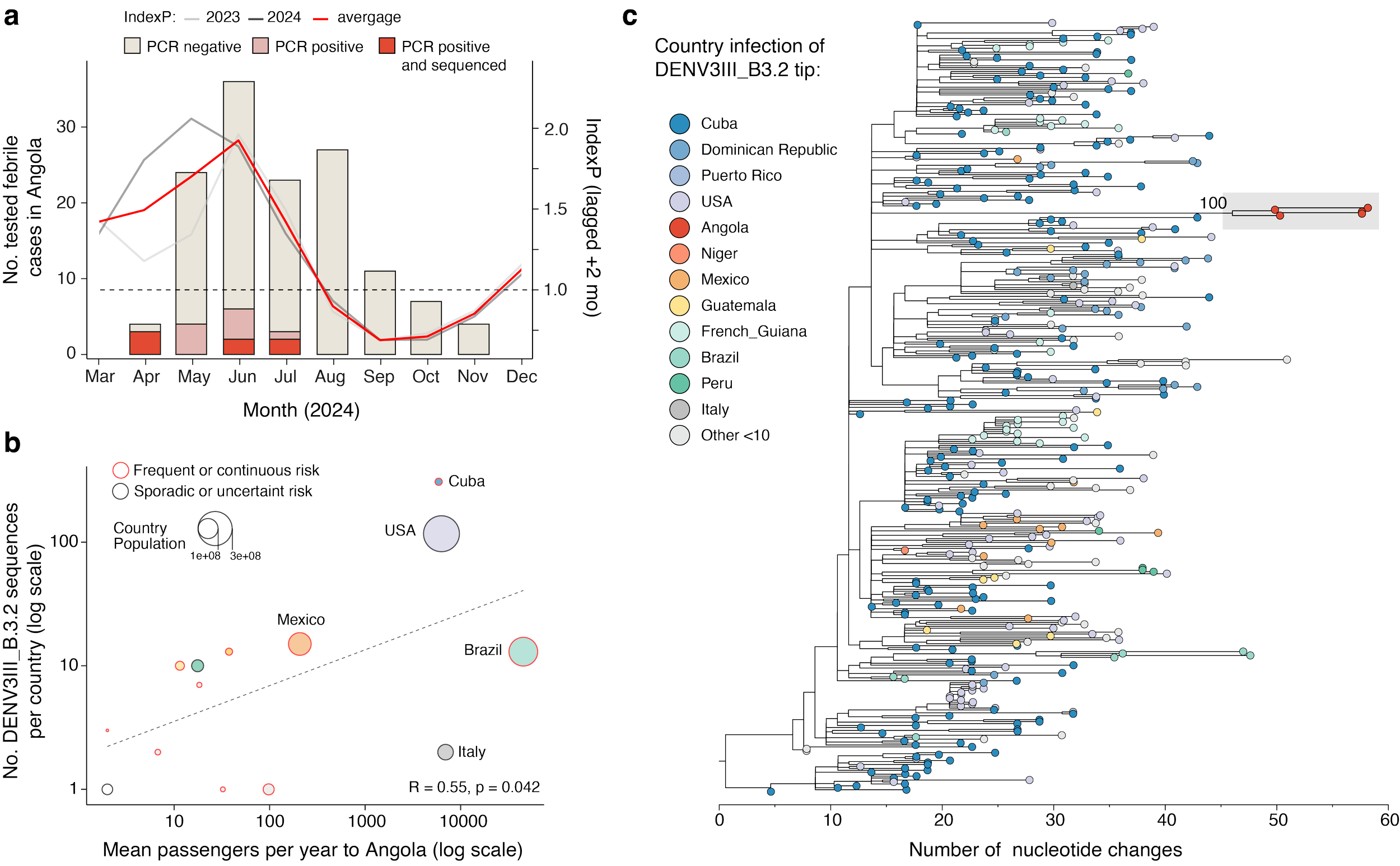
Figure. DENV-3 III_B.3.2 in Angola, 2024. (a) Monthly tested febrile cases in Luanda Province, stratified by PCR result and whether sequencing was attempted, against the Aedes aegypti transmission-suitability Index P. All positive cases fall within April–July, the wet-season peak. (b) Publicly available DENV-3 III_B.3.2 genomes per country versus passenger flows to Angola — sampling tracks travel volume (R = 0.55, p = 0.042). (c) Phylogenetic tree of DENV-3 III_B.3.2; the six Angolan sequences (red) form a single well-supported clade closest to recent strains from the Americas.
The work — carried out under the FEEVIR Consortium and the DeZi Network, with Angola's National Arbovirus Surveillance programme — illustrates how routine genomic surveillance can detect cryptic circulation early, and reinforces the case for sustained sequencing capacity across countries in Africa to better understand dengue circulation on the continent.