

Zoonotic yellow fever in São Paulo, Brazil
Abstract
Yellow fever virus (YFV) continues to threaten human and wildlife populations in the Americas, yet its transmission at the forest–urban interface remains unclear. Here we integrate ground- and canopy-level mosquito surveillance, systematic monitoring of non-human primate carcasses and viral metagenomics to describe the dynamics of a sylvatic YFV outbreak in a 186-hectare Atlantic Forest fragment embedded within metropolitan São Paulo, Brazil, between 2017 and 2018. Our analyses reveal that transmission was primarily driven by a single genetic cluster introduced during a period of high abundance of the main vector, Haemagogus leucocelaenus mosquitoes. A near-complete hepatitis A virus genome was detected in a YFV-infected howler monkey, suggesting potential co-infections at the human–wildlife interface. Phylogenetic and epidemiological modelling estimated a basic reproduction number, R0, for sylvatic yellow fever of 8.2 (95% CI 5.1–12.2), substantially higher than previous estimates for urban outbreaks. Our findings demonstrate that multisource surveillance could provide actionable early warnings in regions at risk for zoonotic spillover.
______
Behind the paper
This study builds on collaborations between public health institutions, field biologists and academic partners working on YFV in the Atlantic Forest. Decades of surveillance by the Superintendency for the Control of Endemic Diseases (SUCEN) and partners laid the foundation for the datasets used here.
The key to our study was combining multisource empirical observations with metagenomics, phylodynamics and transmission modelling, which revealed how a single viral introduction during a brief ecological window achieved an R₀ sufficient to drive rapid local extinction. Metagenomic sequencing also unexpectedly uncovered HAV, reinforcing its value in complex ecological settings.
Our work reflects contributions from many teams across Brazil and provides a high-resolution reconstruction of a sylvatic YFV outbreak at the forest–urban interface. The disappearance of Alouatta from PEAL is a reminder that wildlife health, and its sentinel warning for human disease, is inseparable from the ecological conditions that govern zoonotic transmission risk.
______
From the editor
"This study stood out to us due to the in-depth surveillance data including mosquitoes and non-human primates to study yellow fever virus dynamics at a location potentially important for spillover — the urban–forest interface. These data could potentially inform public health policies and conservation efforts." Editorial Team, Nature Microbiology.
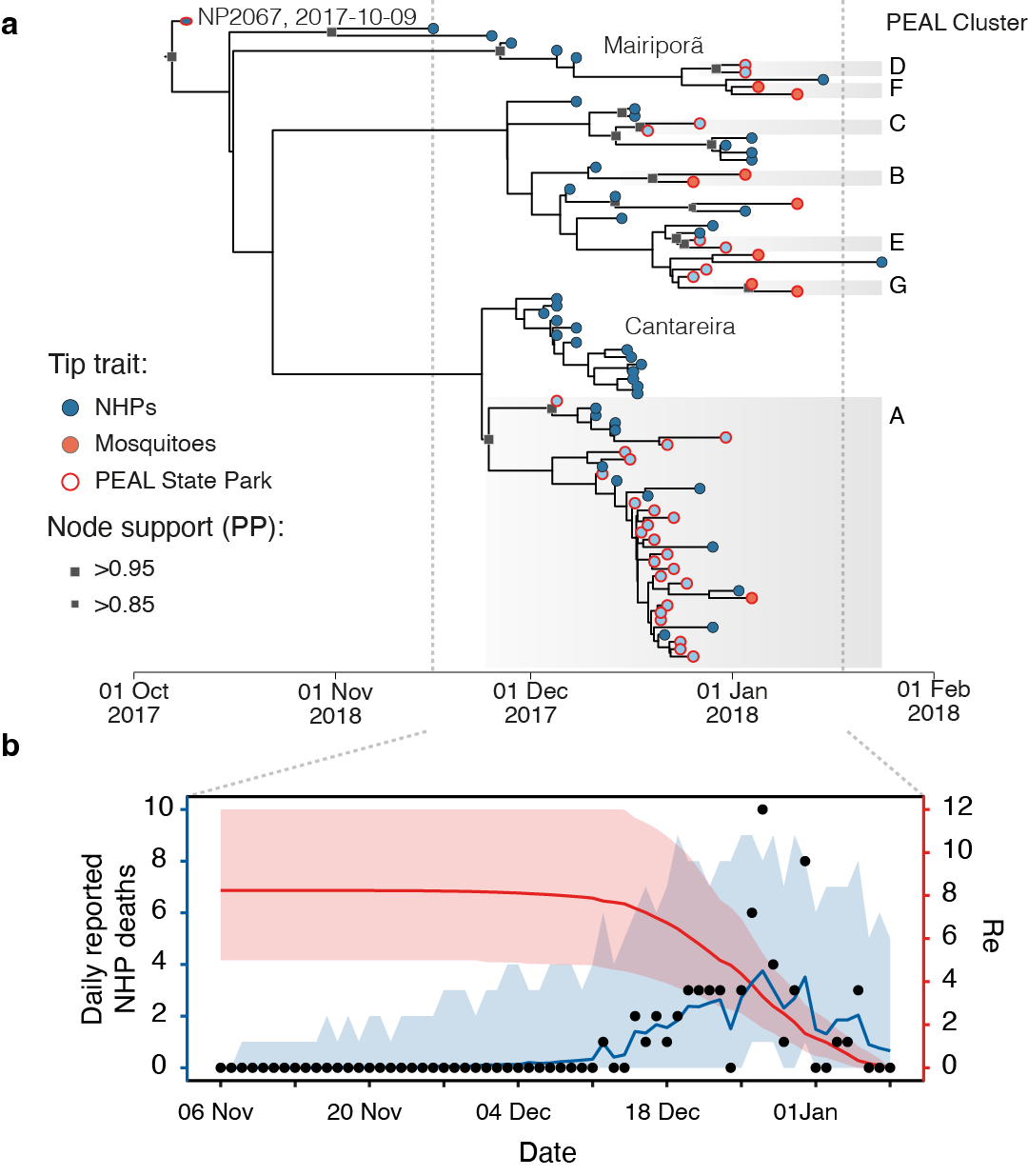
Figure 1. Timing, spread and epidemiological impact of YFV introductions in PEAL State Park.
a, Time-calibrated phylogeny of YFV genomes from PEAL and surrounding areas, showing seven distinct transmission clusters (A–G). Tips are annotated by host (blue circles; howler monkey) or vector (pink circles; Haemagogus mosquito); circles outlined in red were sampled inside the park. Node support is indicated by squares (posterior probability (PP): large > 0.95, small > 0.85). GI–GIII, groups I–III; NHP, non-human primate.
b, Epidemiological dynamics of YFV at PEAL. The right axis shows the estimated effective reproduction number (Rₑ, orange line) over time, overlaid with model fit to daily reported howler monkey deaths (left axis, blue line). The shaded ribbons show 95% credible intervals. Peaks in Rₑ align with the inferred onset of sustained transmission for cluster A, illustrating how a single introduction during a favourable ecological window can trigger rapid epizootic growth and primate mortality. © 2026, Telles-de-Deus, J. et al., CC BY 4.0.
______
Context
International collaboration and local capacity building are advancing genomic surveillance at the intersection of wildlife, ecosystems, and human health, strengthening preparedness for future outbreaks at the urban-forest interface. Video featuring Prof. Nuno Faria, and collaborators Prof. Ester Sabino, Dr. Ingra Claro, Jocelyne Vasconcelos, and Dr. Daniel Grakauskas Ramos from the Brazilian Ministry of Health.